There is a new channel sending over a billion visits per month to websites, and the majority of businesses have done nothing to show up in it.
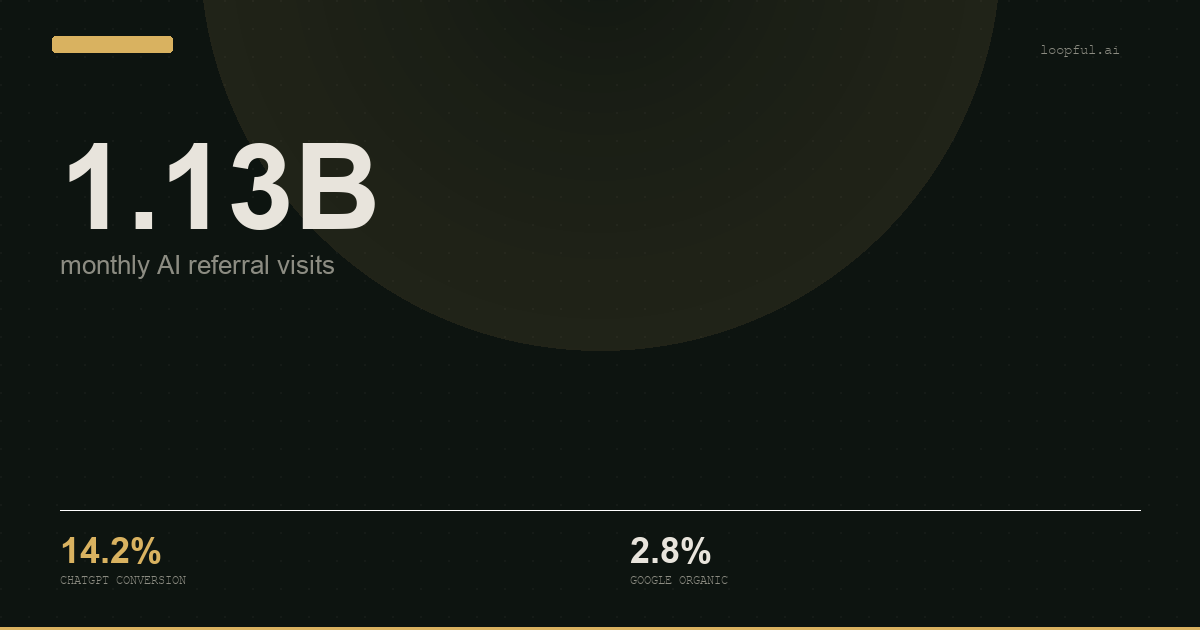
AI search — answers generated by ChatGPT, Google AI Overviews, Perplexity, Gemini, and others — now drives 1.13 billion referral visits monthly. That is a 357% increase year-over-year, based on RankScience traffic analysis data. And according to Seer Interactive, ChatGPT referral traffic converts at 15.9%. Perplexity converts at 10.5%. Compare that to Google organic at roughly 2.8%.
These are not projections. This is traffic that already exists, already converts, and already picks winners.
The question is whether your brand is one of them.
Next step
Find out whether your site is machine-readable enough to earn mentions.
Use SchemaX to scan your highest-value pages and see where your services, entities, and page intent are still too ambiguous for search and AI systems.
Most brands are not in the conversation
A Metricus audit of 50 brands found that 77% scored below 5 out of 100 on AI visibility. Not low visibility — nearly zero. When someone asks ChatGPT or Perplexity for a recommendation in your category, your business is likely not mentioned at all.
AirOps research makes it worse: 26% of brands receive zero mentions in Google AI Overviews. And only 20% remain visible across five consecutive identical queries. Meaning even brands that do appear are inconsistent — mentioned once, then gone the next time someone asks.
SparkToro tested 2,961 prompts across multiple AI platforms and found less than 1% repetition of the same brand lists across answers. The AI recommendation landscape is volatile, fragmentary, and unpredictable. But the brands that show up consistently share observable traits.
Why AI visitors convert at 5x the rate
People who arrive from an AI answer are different from people who click a Google blue link.
They asked a specific question. The AI gave a specific answer. Your brand was named as a credible option. By the time they land on your site, they have already been pre-qualified by the AI's recommendation.
RankScience data shows ChatGPT visitors convert at 14.2% compared to 2.8% for Google organic — a 5.1x advantage. Visitors from AI search also view 3.2x more pages per session and spend 4.1x longer on-site. First-visit conversion sits at 73% from AI referrals versus 23% from Google.
This is not marginal uplift. This is a structurally different kind of visitor with structurally higher intent.
And when your brand is absent from these AI-generated answers, those visitors go directly to whichever competitor the AI names instead. Not to page two of Google. To the competitor's checkout page.
What makes AI answers cite one brand over another
AI answers are not random. Research from Princeton, Georgia Tech, and IIT Delhi across 10,000 queries reveals patterns in what gets cited.
Structured data is a strong signal. Pages using three or more schema types earn 61% of all AI citations. Schema markup appears in 65% of Google AI Overview citations and 71% of ChatGPT citations. This is not proof of causation, but it is the strongest correlation the industry has measured.
One GEO data provider reports that pages with a "triple schema stack" — typically Organization + Service or LocalBusiness + FAQPage — receive 1.8x more citations than pages with a single schema type alone.
Content freshness matters. According to data aggregated by multiple GEO researchers, 76.4% of ChatGPT citations come from pages updated within the last 30 days. Stale content gets deprioritized.
Third-party mentions carry weight. Between 85% and 86% of AI citations pull from third-party pages, not from the brand's own website. Editorial mentions carry roughly 2:1 weight compared to brand-owned claims. Brands listed on Wikipedia are 3.6x more likely to appear in AI answers. Reddit mentions above a certain threshold correlate with a 3x increase in citation likelihood.
FAQ content performs well. Frase research found that pages with FAQ schema achieve a 71% citation rate. Pages with multimodal content — images, video, structured Q&A — see 156% higher citation rates overall.
The attribution gap is your opportunity
Nobody has clean attribution for GEO yet. There is no "AI Overviews" channel in Google Analytics. There is no definitive controlled experiment proving that adding schema type X causes Y% more AI citations.
That is actually the point.
The companies that wait for perfect attribution data before acting will be years late. Attribution follows adoption, not the other way around. Google Analytics did not have robust multi-touch attribution when companies first started investing in SEO. The businesses that moved early captured organic positions that late movers never recovered.
The same dynamic is playing out now with AI visibility. Early movers are establishing structured data coverage, building entity clarity, and earning consistent citations while competitors wait for someone to prove it works.
By the time the proof is definitive, the positions will be taken.
What you should actually do
Forget the hype cycle for a moment. The practical steps are straightforward:
1. Audit your structured data right now
Check what schema markup currently exists on your site. Most businesses find one of three situations: no schema at all, outdated schema left from a previous build, or plugin-generated schema that does not match the actual page content. All three hurt you in AI contexts because they create ambiguity about what your business does and where it operates.
2. Implement a triple schema stack
At minimum, your key pages should carry three complementary schema types. For service businesses, that typically means:
- Organization on every page (who you are)
- Service or LocalBusiness on relevant pages (what you do, where)
- FAQPage on pages with genuine Q&A content (supporting evidence)
Princeton and Georgia Tech data shows this combination correlates with the majority of AI citations. It is the single highest-leverage structural change you can make.
3. Keep your markup in sync with reality
Schema drift — the gap between what your structured data says and what your pages actually contain — is a silent visibility killer. A Metricus audit found that 41% of brands had wrong pricing in their AI profiles and 34% had outdated feature descriptions. These errors originated from stale structured data that nobody maintained.
Every time you update a service page, add a location, change pricing, or modify an FAQ, your schema needs to reflect that change. Structured data is not a one-time implementation. It is an operational discipline.
4. Build third-party credibility signals
Since 85%+ of AI citations come from third-party pages, your own website is necessary but not sufficient. Get mentioned in comparison articles (32.5% of AI citations use comparison format), earn editorial coverage, and ensure your brand appears in the directories and review platforms that AI systems trust.
5. Update content frequently
The 30-day freshness window for ChatGPT citations means that static "set it and forget it" content strategies are increasingly penalized. The pages that earn citations are the pages that demonstrate current relevance.
The gap is expensive and widening
Gartner forecasts a 25% drop in traditional search volume by 2026 as queries shift to AI-generated answers. The GEO market is projected to grow from $848 million in 2025 to $33.7 billion by 2034, a 50.5% compound annual growth rate according to Dimension Market Research.
Meanwhile, 900 million people use ChatGPT weekly. Google AI Overviews reach 2 billion monthly users across 200+ countries. Perplexity has grown 800% year-over-year to approximately 45 million monthly active users. 37% of consumers already start their searches with AI rather than Google.
The businesses that act on this now will capture the high-converting AI referral traffic that is already flowing. The businesses that wait will find themselves in the same position as companies that ignored SEO in 2010: aware that something happened, unable to recover the ground they lost.
Structured data is not the only factor. But it is the one you control, the one with the strongest empirical correlation to AI citations, and the one that most of your competitors have not implemented properly.
That gap between what is known and what is acted on? That is where the advantage lives.
SchemaX scans your site, identifies schema gaps, and generates review-ready structured data aligned to what AI systems actually look for. No guesswork. No plugin soup. One operational workflow that keeps your machine-readable layer in sync with your business.
Next step
Move from theory to machine visibility work that actually ships.
Scan the site, review the suggestions, and deploy schema through the same workflow instead of leaving machine understanding to guesswork.