Nächster Schritt
Prüfen Sie, ob Ihre Website klar genug für Suchmaschinen und KI-Systeme beschrieben ist.
Nutzen Sie SchemaX, um Ihre wichtigsten Seiten zu scannen und zu sehen, wo Leistungen, Entitäten und Seitenintentionen für Suche und KI noch zu unklar sind.
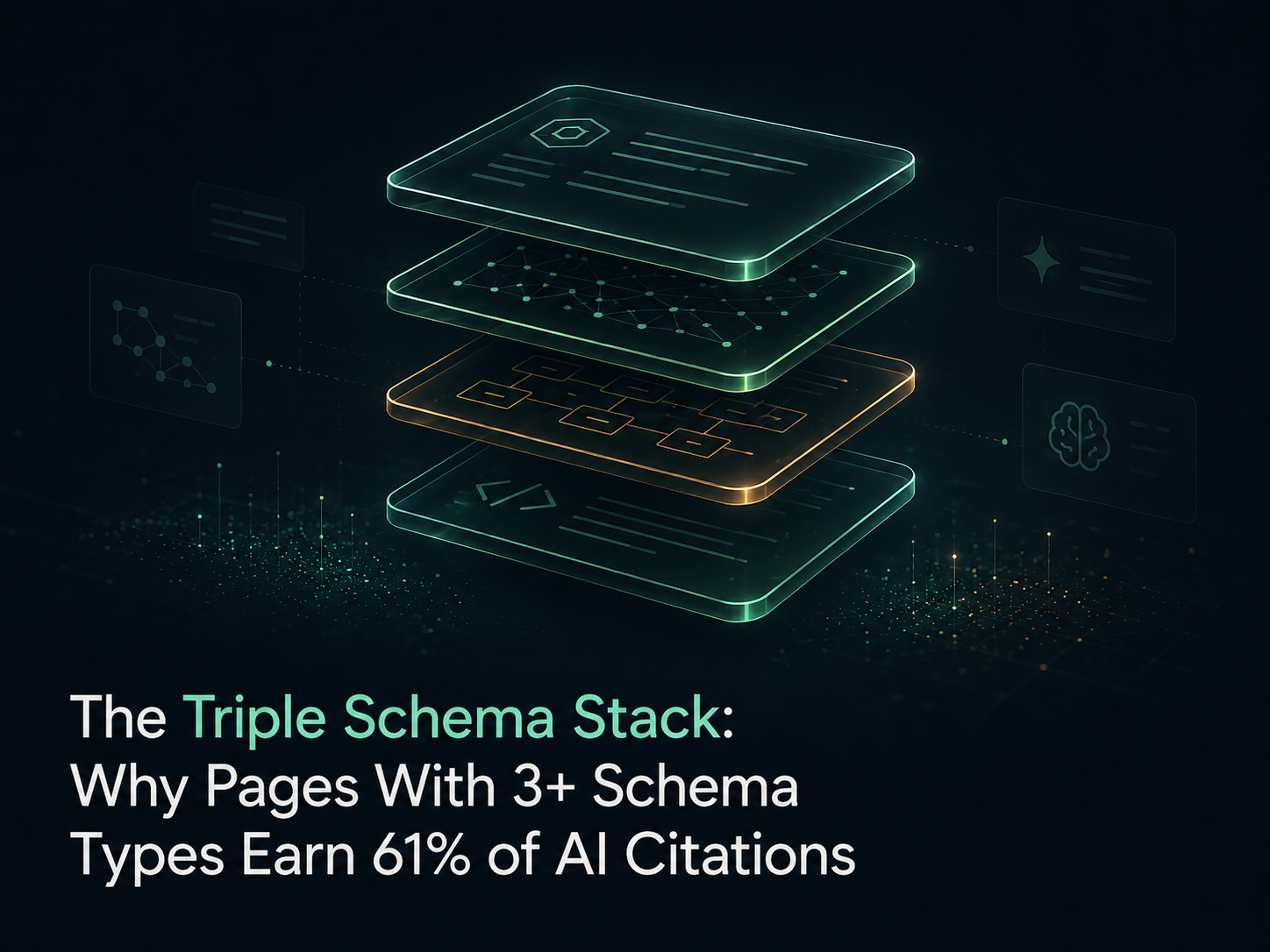
There is one structural change that correlates more strongly with AI citations than any other single factor: deploying three or more complementary schema types on a page.
A Princeton and Georgia Tech study across 10,000 queries found that pages using three or more schema types earn 61% of all AI citations. Not 61% more citations. 61% of all citations. Period.
That finding has been corroborated by GEO data providers reporting that pages with a "triple schema stack" receive 1.8x more citations than pages with a single schema type. Schema markup is present in 65% of Google AI Overview citations and 71% of ChatGPT citations, according to aggregated data from multiple GEO research sources.
The industry does not yet have clean causal attribution. No one has run a controlled experiment that isolates schema as the variable. But the correlation is strong enough that waiting for proof is more expensive than acting on the signal.
What a triple schema stack actually looks like
The concept is simple. Instead of deploying one schema type per page — which is what most CMS plugins and SEO tools produce — you layer three complementary types that together describe the entity, the offering, and the supporting evidence.
For a service business, the most effective combination is:
Layer 1: Organization schema
Present on every page. Establishes your canonical business identity — name, URL, contact details, social profiles, founding date. This is the base layer that tells AI systems who you are across every page they encounter.
Without this, each page is an orphan. AI systems have to infer the relationship between pages and the business entity. With Organization schema, you make that relationship explicit.
Layer 2: Service or LocalBusiness schema
Present on pages describing what you do and where you do it. Service schema connects a specific offering to the page where that offering is explained. LocalBusiness schema adds geographic specificity — address, service area, operating hours.
For businesses that serve clients in specific locations, LocalBusiness schema is not optional. For businesses that sell services without geographic constraints, Service schema paired with the Organization layer is the better fit.
Layer 3: FAQPage schema
Present on pages containing genuine questions and answers. This is the evidence layer. It gives AI systems structured access to the specific claims, clarifications, and qualifying details that support citation.
Frase research found that pages with FAQ schema achieve a 71% citation rate in AI-generated answers. That is not surprising — AI systems generating responses to user questions are naturally drawn to content that is already structured as questions and answers.
But the critical word is "genuine." FAQ schema applied to pages without actual FAQ content is worse than useless. It creates a signal-to-content mismatch that AI systems can detect and penalize.
Why three types outperform one
The reason is not technical complexity. It is information density.
A single schema type tells AI systems one thing about a page. Organization schema says "this page belongs to this business." That is useful but incomplete. The AI system still needs to determine what the page is about, what services are described, what evidence supports the claims, and whether the content is current.
Three complementary schema types answer all of those questions explicitly:
- Who is behind this page (Organization)
- What is being offered or described (Service / LocalBusiness)
- What evidence supports the claims (FAQPage)
Each layer reduces the ambiguity that AI systems have to resolve through inference. Less inference means higher confidence. Higher confidence means more citations.
The 1.8x citation multiplier for triple stacks over single schema types reflects this: AI systems prefer pages where less guessing is required.
The implementation mistakes that kill citation potential
Having three schema types is necessary but not sufficient. The most common mistakes:
Conflicting entity details
Organization schema says the business name is "Smith Marketing LLC." The LocalBusiness schema says "Smith Digital." The Service schema references "Smith Agency." AI systems encountering three different names for the same entity do not average them — they reduce confidence in all of them.
Every schema type on every page must use identical entity details. Same name, same URL, same contact information. Zero variation.
Schema that contradicts page content
A Service schema describing "comprehensive SEO auditing" on a page that only discusses content marketing is not just unhelpful — it is actively harmful. AI systems cross-reference schema claims against visible page content. When they do not match, the schema becomes a negative signal.
Every schema property must be supported by corresponding content on the page. If the page does not discuss it, the schema should not claim it.
Stale schema after content updates
This is the most common and most invisible failure mode. The page gets updated. The schema does not. Now your structured data describes a version of the page that no longer exists.
A Metricus audit found that 41% of brands had wrong pricing in their AI-visible profiles and 34% had outdated feature descriptions. These errors trace directly back to schema that was not updated when the underlying content changed.
Schema maintenance is not a quarterly task. It is a content change trigger. Every time the page changes, the schema must change with it.
Plugin-generated schema without review
Most CMS schema plugins generate markup automatically based on page templates and field mappings. The resulting schema is often technically valid but strategically wrong: generic Organization schema with placeholder values, Article schema on pages that are not articles, missing Service schema on actual service pages.
Automated generation is fine as a starting point. Automated deployment without human review is where citation potential dies.
How the triple stack connects to broader AI visibility signals
Schema markup does not operate in isolation. The Princeton and Georgia Tech research also found that other factors contribute to AI citation probability:
- Content freshness: 76.4% of ChatGPT citations come from pages updated within 30 days
- Third-party mentions: 85-86% of AI citations reference third-party pages; editorial mentions carry roughly 2:1 weight versus brand-owned claims
- Statistical specificity: Adding statistics to content lifts visibility by 30-40%
- Multimodal content: Pages with images, video, and structured Q&A see 156% higher citation rates
The triple schema stack is the structural foundation. These other factors are the content layer. Together, they represent the complete picture of what AI systems use to decide which pages deserve citation.
But structure comes first. A well-structured page with average content will outperform a brilliantly written page with no machine-readable layer. AI retrieval systems evaluate structure before they evaluate prose.
The competitive window is open now
Here is the uncomfortable math:
According to RankScience data, AI search already generates 1.13 billion referral visits monthly — a 357% year-over-year increase. ChatGPT visitors convert at 14.2% versus 2.8% for Google organic. Gartner forecasts a 25% decline in traditional search volume by 2026.
Yet 77% of brands score below 5 out of 100 on AI visibility. 72% have factual errors in their AI profiles. Most have no structured data strategy at all, let alone a triple schema stack.
This gap between the size of the opportunity and the state of preparation is the definition of a competitive window. It will not stay open. As GEO tools proliferate and awareness grows, the brands that implemented early will have months or years of citation history, entity authority, and machine trust that late movers cannot shortcut.
The best time to implement a triple schema stack was six months ago. The second best time is this week.
How to start
If you have zero schema on your site right now, here is the priority sequence:
- Deploy Organization schema site-wide. This takes one implementation and establishes your base entity.
- Add Service or LocalBusiness schema to your top five pages by traffic. These are the pages most likely to be retrieved by AI systems.
- Add FAQPage schema to pages with genuine Q&A content. If you do not have FAQ content on your key pages, write it first. FAQ schema without FAQ content is a negative signal.
- Validate consistency. Run a structured data audit to verify that entity details are identical across every schema instance.
- Set up a maintenance workflow. Schema that drifts out of sync with page content is worse than no schema at all.
This is not a weekend project. But it is a high-leverage one. The 61% citation share that triple-stack pages command is not available to pages without that structure. There is no content quality hack or authority shortcut that replaces it.
The data says structured data matters. The market says most competitors have not acted. The conversion data says the traffic is worth capturing.
Act on all three.
SchemaX automates the heavy lifting: scan your pages, identify which schema types belong where, generate review-ready JSON-LD, and flag drift before it costs you citations. One workflow. Three schema layers. Machine-readable truth that stays in sync.
Nächster Schritt
Gehen Sie von Theorie zu sauber umgesetzter Sichtbarkeitsarbeit über.
Scannen Sie die Website, prüfen Sie die Vorschläge und spielen Sie Schema im selben Workflow aus, statt maschinelles Verständnis dem Zufall zu überlassen.